
Washington County Arrest Report Status
Washington County publishes no 72-hour, weekly, or rolling booking log on any official site. No official site carries one. The county directory lists sheriff and inmate-information phone contacts, nothing more. There is no archive with a stated window or rollover date. The strongest local publication is an Akron News-Reporter piece. It is titled as a Washington County Sheriff's Report. It runs as a dated, text-based account of calls and incidents. That is not a live jail ledger, and the difference matters. A blotter item may describe a call that ended with no arrest. A booking record opens the moment a person enters custody. A docket reflects the case only after filing and appearances. These sources overlap constantly. None fully replaces another. For a multi-day search, keep the pieces apart. Track the event date, the source type, and the agency on their own lines.
Read Washington County Arrest Reports
Begin with what you already know. Scanning unrelated names rarely helps. A place, a date range, and an agency will separate an Akron News-Reporter item from a Justice Center commitment record. The newspaper can narrow a date or describe the call, but official confirmation of a Washington County arrest belongs with the sheriff's office or Washington Combined Court.
- Set a date range that covers the incident plus several later publication days.
- Search the local report by person, road, town, or agency when those details are known.
- Read the article date and any stated report period; do not assume they are the same.
- Separate calls for service from arrests and arrests from completed jail bookings.
- Confirm county custody or request the underlying record from the sheriff.
- Use the official Colorado docket or court request path for later case action and disposition.
The Arrested Today page does a different job. It starts from the official phone route for a possible fresh booking. A multi-day report asks different questions, since the source date and record type matter more than minute-by-minute status. Guessing the two lists together only muddies both.
Washington County Arrest Report Fields
The newspaper report follows no fixed schema. It mentions calls, places, and incident types. It lacks the fields a jail booking record would carry. The table below explains what each element means when it shows up. It also notes where to verify each item. Never patch missing facts from an unrelated directory or photo site.
| Possible entry element | How to interpret it |
|---|---|
| Article or report date | Publication date, which may follow the event date. |
| Incident date and location | When and where a reported call occurred, not proof of booking. |
| Named agency | The office tied to the call, arrest, or public-information report. |
| Person’s name | An identifier that must be matched carefully against an official record. |
| Alleged offense | An charge or initial charge, subject to court changes. |
| Commitment or discharge | Sheriff-held jail data, not a standard news-blotter field. |
| Booking photograph | No current Washington County log photo policy is verified. |
| Disposition | The court’s result, not something inferred from a blotter. |
Colorado law sets out categories of criminal-justice information. They include identity, agency, date, place, charges, offenses, and dispositions. That framework does not force every field onto a public web page. Nor does it turn a newspaper summary into the official record. The custodian weighs access, redaction, sealing, and protected details.
Washington Arrest News Runs Later
The observed Akron News-Reporter sheriff report shows that local textual coverage exists.
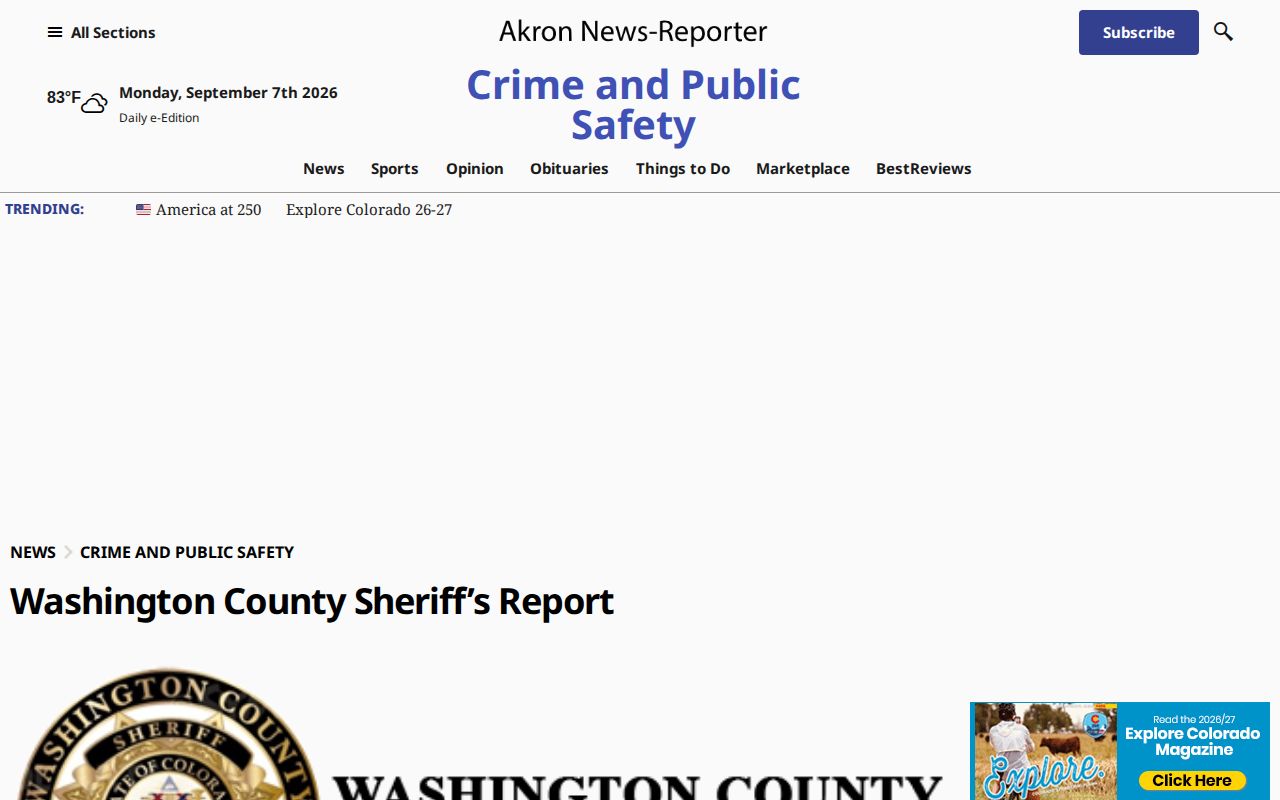
A local article adds context. It still cannot prove current custody, full arrest coverage, or a steady schedule. Washington County runs on three clocks. The custody clock starts at arrest and intake. The publication clock starts when a reporter or agency writes a public account. The court clock follows filings, advisement, hearings, and disposition. Washington Combined Court posts a daily advisement and bond-hearing time. That schedule says nothing about when news appears. A late article can describe an earlier call. A court entry can surface well after the first custody inquiry. Nothing promises reports every day, after every weekend, or on holidays. Widen the span when an event fell near a weekend. Then confirm the date with the sheriff or court. Treat all of this as a delay allowance. It is not proof of any surge in Washington County arrests.
Washington County Blotter Sources
The COGenWeb Washington County news page names the Akron News-Reporter as the current county newspaper. It also adds historical title context.
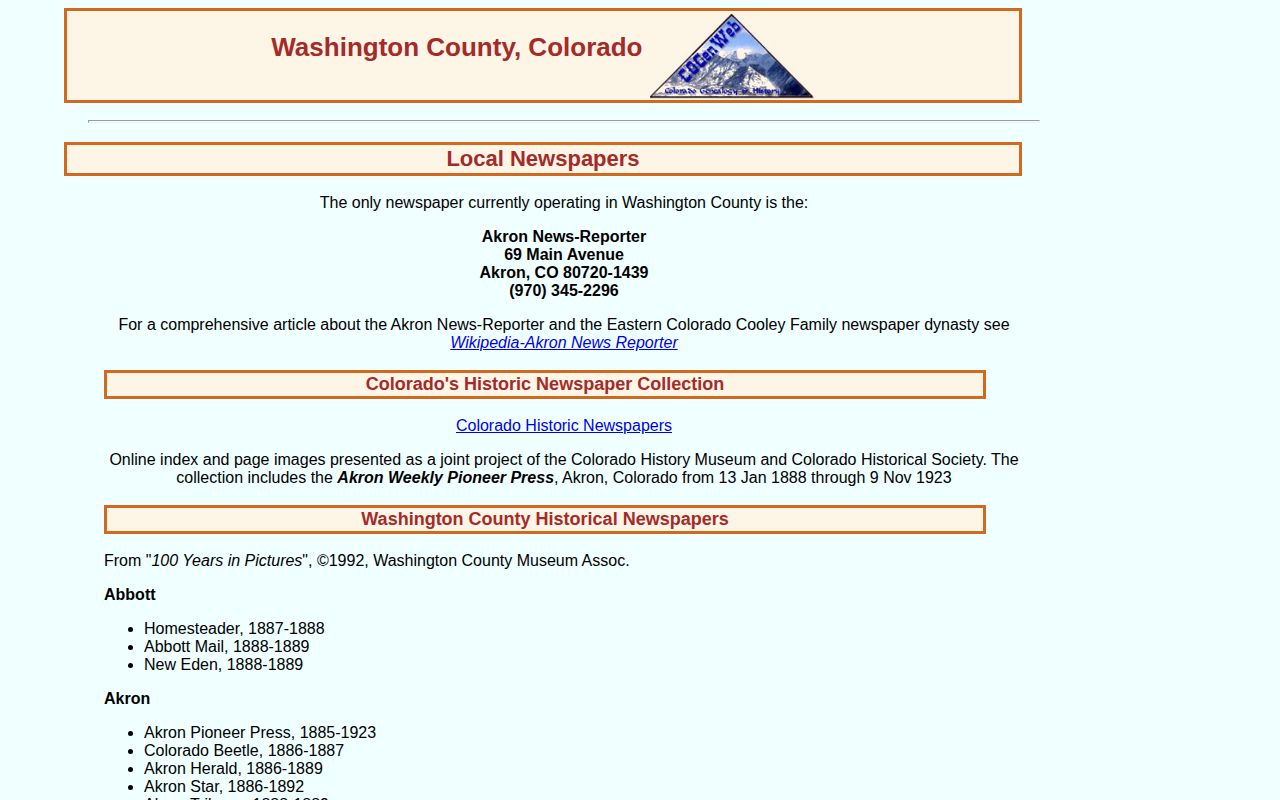
COGenWeb helps trace press names. It is not a custody database or a current sheriff archive. The Otis Telegraph shows up in historical and legal-newspaper references. It carries no current arrest or mugshot coverage. Colorado Historic Newspapers and Library of Congress catalog records assist with older newspaper discovery. Those collections can preserve an article after a publisher page vanishes. They remain selective press records, not complete daily commitment and discharge books. Third-party arrest aggregators run weaker still. RecentlyBooked's Colorado index omits Washington County, and its local path no longer exists. Mugshots.com carries a Washington County page stocked with what looks like historical material. That is not a current roster. Arrests.org offers a statewide search but no local section. Such services go stale, run incomplete, or simply err. None can confirm custody or a final charge. Sheriff and court sources always come first.
Unofficial Washington Arrest Listings
The RecentlyBooked Colorado index illustrates how thin third-party coverage runs. It serves as a warning about aggregator gaps, not a record source.
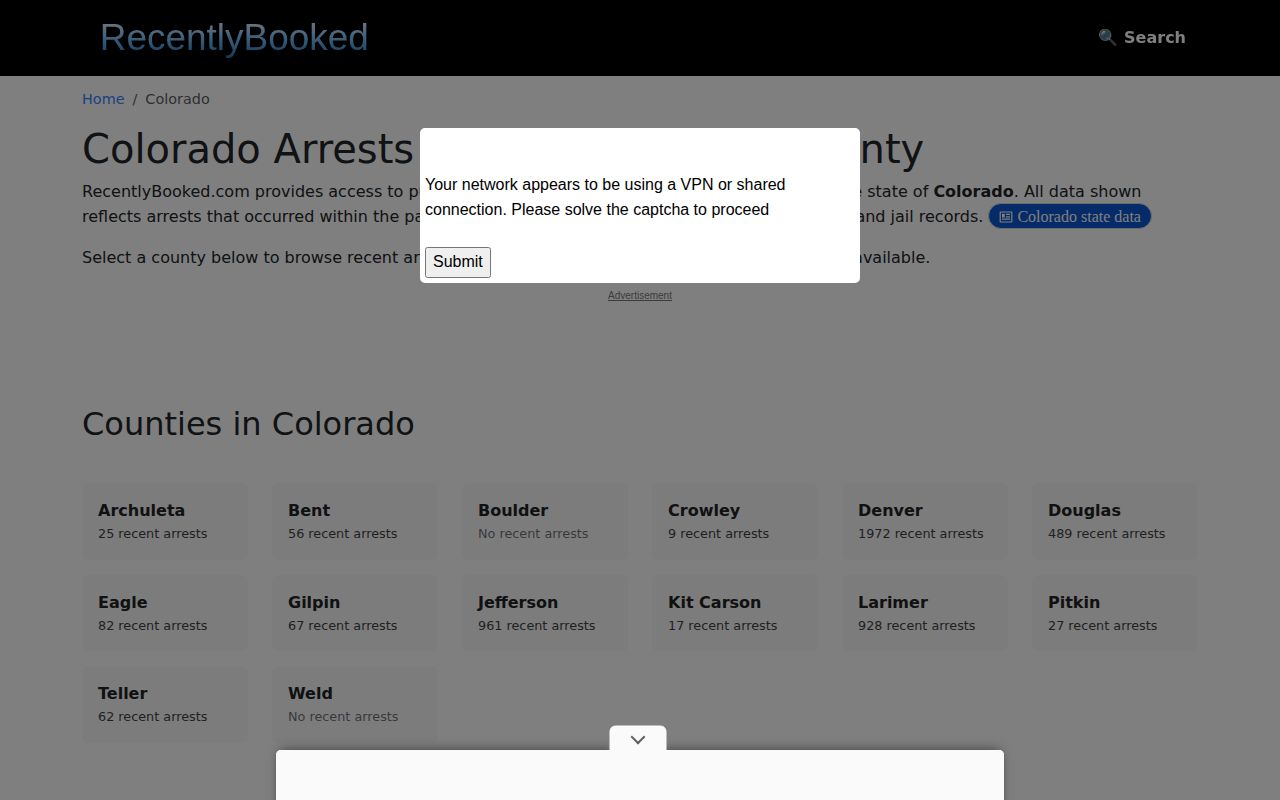
Aggregator sites offer arrest listings that look official. They are not. The index carries no verified Washington County section at all, which leaves a real gap next to the sheriff's own log.
Stale data is the core problem. A third-party page can linger online long after the county has released someone from custody. The reverse happens too. A missing aggregator page tells you nothing about whether a booking record still exists with the sheriff. For answers, contact the office that holds the record instead of relying on copied names and booking photos from unofficial rosters.
Washington County Arrest Report Archives
Older Washington County arrest reports follow state retention rules. The Colorado Sheriff's Record Retention Schedule is the best map of what jails keep. The daily record of jail commitments and discharges is permanent. That daily log can hold plenty: entrance date, name, offense, sentence term, fine, age, sex, and citizenship. It also records who did the committing and discharging. Inmate case files go further. They may hold criminal history, fingerprints, mug shots, arrest records, release orders, and confinement papers.
Retention periods differ by case type. Major felony and violent-crime files stay permanent. Other felony files last ten years after release, while misdemeanor, petty-offense, and traffic files last three. Some sexual-assault files carry a far longer period. These are statewide guideposts, so Washington County did not necessarily adopt every schedule, and holding an item does not mean releasing it without review.
Destruction has limits too. A sheriff needs approval to use the schedule, and pending cases, claims, actions, and audits block it entirely. Ask the county custodian whether a series moved. The Colorado State Archives catalog can be searched by Washington County, sheriff, Justice Center, jail, commitments, court, and date span. An archive index entry does not mean a booking photo is digitized.
Confirm Washington Arrest Report Outcomes
A recent Washington County arrest starts with the sheriff. Call the Washington County Sheriff's Office at (970) 345-2244. Automated inmate information runs at (970) 514-3145. The office lists no separate records-unit line, so ask the main desk for the current custodian and the right request route. Give the person's name, the approximate date, the arresting agency, and the exact record parts you want. Precise requests find the right series faster.
Court papers tell the rest of the story. The Colorado Judicial Branch public-records access guide explains why a docket search or commercial register never equals the full official file. Washington Combined Court carries the docket and disposition path. Disposition simply means the court-recorded outcome. It shows whether an early charge was dismissed, changed, or resolved.
Never read an outcome from a booking photo, a sheriff report, or silence in a news archive. A search may return several similar cases. Sort them by courthouse, filing date, and party details. Then request the actual record instead of trusting a search-result summary.